
Engineered moving payload
Assess component mass, centre of gravity, gripper mass, moments and acceleration together rather than using headline payload alone.
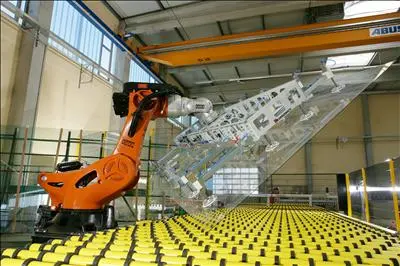
Automate the movement of heavy, bulky or high-inertia parts with the robot, tooling, base structure, safeguarding and motion strategy engineered as one system.
The strongest projects start with a clear operating problem, measurable output requirement and defined product route.
Components are too heavy or awkward for consistent manual handling
Lifting equipment slows a repetitive production cycle
Large parts must be placed accurately into a fixture or process
The operation exposes people to pinch, crush, heat or sharp-edge hazards
The robot is one element. Success is measured by controlled movement, usable production flow and practical operation.
Assess component mass, centre of gravity, gripper mass, moments and acceleration together rather than using headline payload alone.
Plan approach angles, clearance, support and speed through the full envelope of the part—not just the robot wrist.
Match bases, frames, fixtures and guarding to static and dynamic loads generated by the complete application.
We define the equipment and interfaces needed to move from a robot demonstration to a production-capable cell.
Mass, centre of gravity, inertia, moments, acceleration and emergency-stop behaviour.
Payload, reach, wrist capacity, mounting orientation and environmental protection.
Mechanical, vacuum, magnetic, fork or hybrid gripping with loss-of-grip monitoring.
Robot base, gantry, frames, fixtures and floor requirements.
Separation, access, stored energy, load retention and recovery controls.
An offset load can exceed wrist limits even when its mass is below the robot's nominal payload.
The gripper should maintain or safely manage the load during power, air or vacuum loss as the risk assessment requires.
Long parts sweep a much larger area than the robot arm and can create additional collision and guarding constraints.
Foundation capacity, fixing method and surrounding structures need review before the final layout is approved.
Final answers depend on your product, rate, layout and surrounding equipment.
Oxford Industrial Automation lists representative industrial robot platforms up to 300 kg. Final suitability depends on tooling, centre of gravity, reach, moments, cycle and environment—not payload mass alone.
Yes, where suitable gripping, support, clearances and load calculations can be achieved. Large area and flexible panels may need multi-zone vacuum, frame support or additional sensing.
Sometimes. Base reactions, dynamic loads and the existing floor are reviewed so the correct foundation and fixing arrangement can be specified.
Send the product, weight, pickup and placement details, target output and a photo or video of the current process. We will define the next technical step.