
Repeatable machine service
Coordinate pickup, door or fixture access, machine-ready signals and finished-part discharge around the real production cycle.
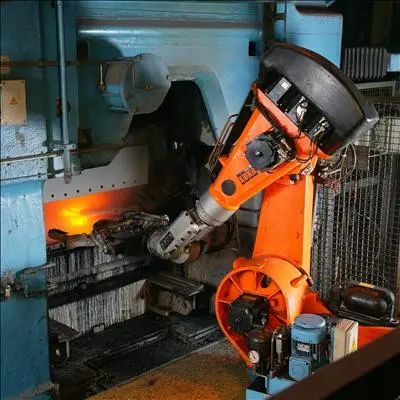
Move components into and out of machines, fixtures, conveyors, stillages and process equipment with a cell engineered around access, cycle signals, gripping and safe operator interaction.
The strongest projects start with a clear operating problem, measurable output requirement and defined product route.
Repetitive manual loading or unloading limits output
Parts are hot, sharp, heavy, oily or awkward to handle
A machine can run longer with reliable part presentation
Operators are required for monotonous transfer rather than skilled work
The robot is one element. Success is measured by controlled movement, usable production flow and practical operation.
Coordinate pickup, door or fixture access, machine-ready signals and finished-part discharge around the real production cycle.
Grip and place components consistently while accounting for surfaces, orientation, residual heat and part variants.
Plan loading points, replenishment, inspection and fault recovery as deliberate parts of the cell rather than afterthoughts.
We define the equipment and interfaces needed to move from a robot demonstration to a production-capable cell.
Trays, conveyors, stillages, feeders, pallets or vision-guided pickup.
Reach, payload, wrist loading and gripper selected for the complete moving mass.
Door, chuck, clamp, cycle, permissive and fault handshakes.
Discharge, inspection, marking, washing, stacking or downstream transfer.
Safeguarding, access control and operating modes based on the complete risk assessment.
The approach path must clear doors, tooling, fixtures and other machine features throughout the cycle.
Part, gripper, adapters, services and dynamic loading all count—not the component alone.
The control strategy should define what happens after a missed pick, machine alarm or interrupted cycle.
Product recipes, adjustable nests and tool-change methods should match the required format range.
Final answers depend on your product, rate, layout and surrounding equipment.
Yes, where the cycle, reach and part presentation allow it. Dual grippers can sometimes exchange a finished part for a new blank in one visit, but the correct approach depends on payload, access and takt time.
Often, yes. We review the available electrical signals, safety circuit, doors, fixtures and control permissions before confirming the interface and responsibility split.
Options include fixed nests, trays, pallets, stillages, conveyors, bowl or step feeders and vision-guided bin or belt picking. The best method is driven by part geometry, rate and autonomy target.
Send the product, weight, pickup and placement details, target output and a photo or video of the current process. We will define the next technical step.