
Consistent stack geometry
Control offsets, orientation, layer patterns and placement height from the first item to the completed stack.
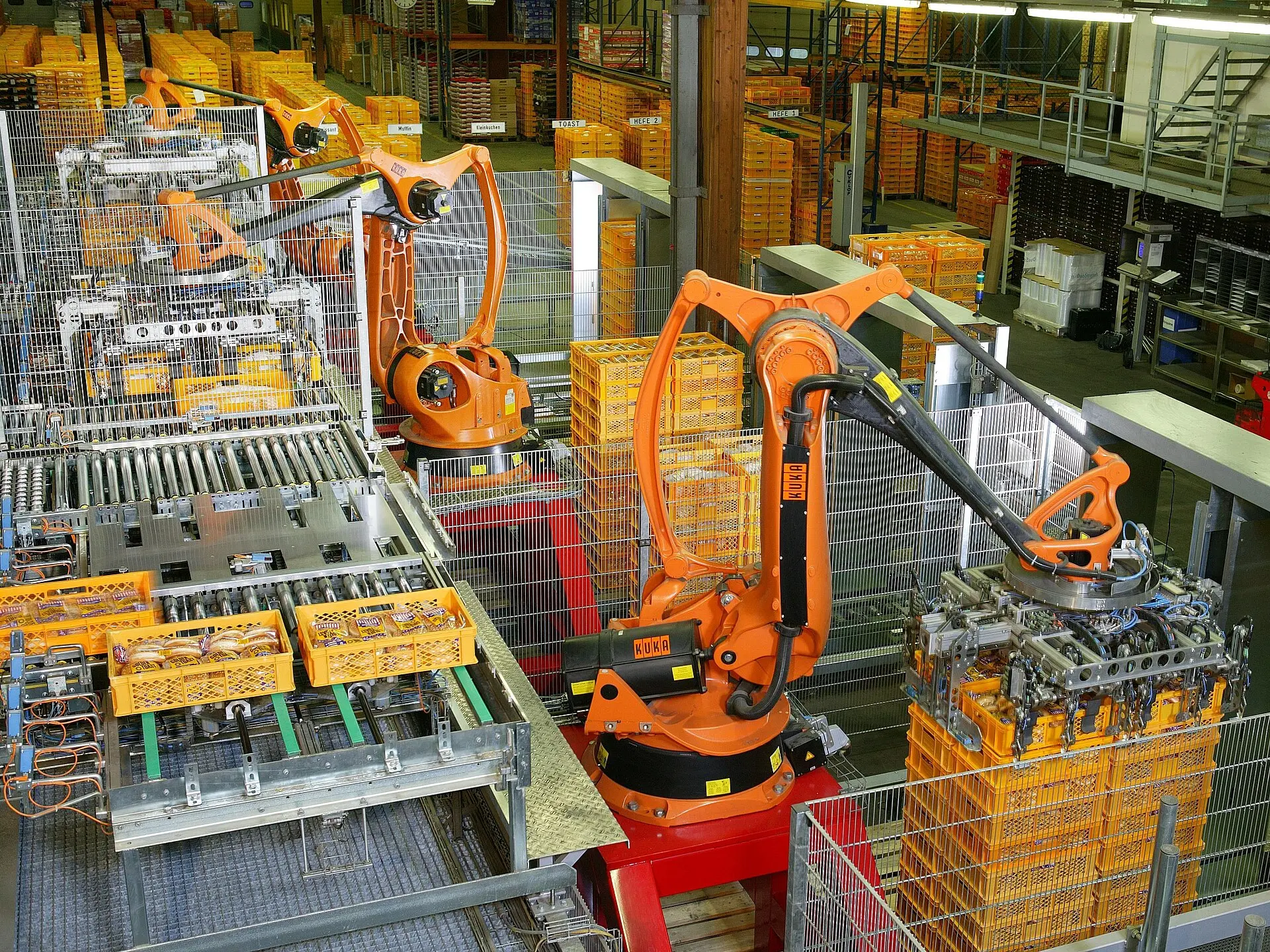
Build, separate and transfer repeatable stacks of components, trays, containers, boards and production materials without relying on repetitive manual lifting.
The strongest projects start with a clear operating problem, measurable output requirement and defined product route.
Products need repeatable layer, row or nested placement
Stacks vary by product, order or downstream process
Manual lifting presents an ergonomic or throughput constraint
Separators, trays or interleaves must be handled with the product
The robot is one element. Success is measured by controlled movement, usable production flow and practical operation.
Control offsets, orientation, layer patterns and placement height from the first item to the completed stack.
Store approved patterns and product parameters for repeatable changeover between formats.
Coordinate separators, empty trays, dunnage, slip sheets or stack discharge within one control sequence.
We define the equipment and interfaces needed to move from a robot demonstration to a production-capable cell.
Singulation, orientation, spacing and presence confirmation before pickup.
Layer geometry, offsets, rotations, nesting and stack-height control.
Vacuum, clamp, fork or combination tooling matched to product and layer handling.
Pallet, trolley, stillage, rack, tray or dedicated fixture.
Conveyor discharge, operator collection, wrapping or transfer to the next process.
Tall, flexible, nested or slippery products need suitable support and placement strategy.
Real product dimensional variation affects cumulative stack accuracy and gripper approach.
Tray, pallet or stillage supply must support the required autonomy period.
Recipe controls should prevent unapproved combinations and make the active pattern clear to operators.
Final answers depend on your product, rate, layout and surrounding equipment.
Palletising is one form of stacking, but many applications build stacks in trays, racks, stillages, trolleys, process fixtures or directly on conveyors. This site covers that broader handling requirement.
Yes. The same project can include destacking, separation, orientation and restacking, subject to reach, cycle time, product variability and the chosen gripper.
Potentially. Layer handling can improve cycle time, but payload, product stability, pattern, tooling mass and available pickup quality must all be assessed.
Send the product, weight, pickup and placement details, target output and a photo or video of the current process. We will define the next technical step.