
Controlled product movement
Grip, move and release the approved product range without losing the required orientation or condition.
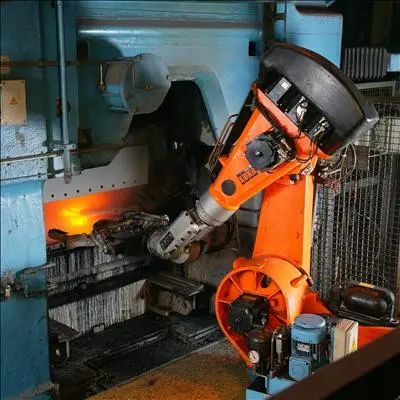
Cobot material handling uses a collaborative robot within a complete cell for tasks such as component transfer, machine support or repetitive handling. Suitability depends on the product and tooling load, reach, target rate, operator tasks and the complete application risk assessment. A cobot arm does not automatically make a cell safe without guarding.
Cobots can suit some lighter, lower-speed or flexible handling tasks. Start with the required transfer and operator work, then assess whether a collaborative or other robot architecture fits the complete duty.
Define the complete product, gripper, adapter and services load
Check reach, clearances and required placement orientation
Compare accepted output with replenishment, waiting and normal recovery
Identify operator access, product hazards and the protective measures required
Assess the complete route from product presentation to accepted placement, including the operator work around the cell.
Grip, move and release the approved product range without losing the required orientation or condition.
Coordinate source and destination readiness, machine signals and the response when the next process cannot continue.
Include replenishment, changeover, empty-container removal and recovery when comparing the cell concept with the required output.
The arm is one component. The cell specification also needs the load, product route, controls and protective measures.
Fixtures, trays, conveyors or other pickup arrangements matched to product variation and the required autonomy.
Product, gripper, adapters, services, centre of gravity, moments and inertia considered throughout the movement.
Control ownership, readiness signals, product hand-off and fault recovery defined before confirming scope.
Replenishment, access, tool changes and recovery included in the layout and operating concept.
Assess product and gripper hazards, speed, force and trapping points. Some cobot cells still require guarding or other protective measures.
Check the combined moving load and its centre of gravity through the full working envelope; headline robot payload alone is not the specification.
Account for detection, gripping, robot movement, placement, machine signals and waiting for upstream or downstream equipment.
Identify who replenishes, inspects, changes tools and recovers the process, then review the required safeguarding and operating modes.
Define representative products, rates, placement quality, fault scenarios and training needed for production handover.
Final robot selection and cell performance are confirmed against the application before order.
No. Collaborative operation depends on the complete application and risk assessment, including the product, gripper, speed, force, sharp or hot hazards and possible trapping points. Some cobot cells still require guarding or other protective measures.
Include the product, end-of-arm tooling, adapters and services carried by the wrist. The combined centre of gravity, wrist moments, inertia and acceleration must also remain within the selected robot limits throughout the movement.
Assess the complete cycle: product detection, machine signals, gripping and confirmation, robot travel, placement, release and any waiting or normal recovery. Payload, reach, the operator tasks and safety requirements must be assessed alongside the target rate.
Send product dimensions and weight, pickup and placement details, target output, operator tasks and the available layout. We will assess the complete handling requirement before selecting a robot architecture.