
Locate a usable part
Select sensing, optics, lighting and calibration around the product surface and the position information needed for the task.
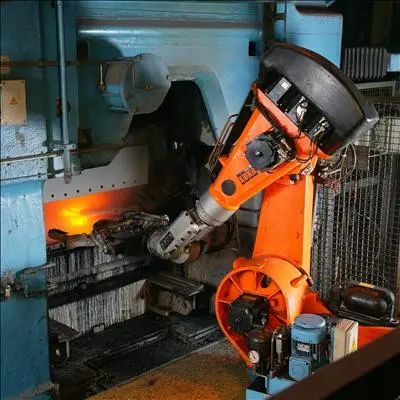
Vision-guided robot handling uses calibrated 2D images or 3D data to locate a product and guide pickup or placement. The camera is one part of the cell: lighting, reachable grips, robot motion, product confirmation and the downstream hand-off must work together.
Flat, separated parts may permit a simpler 2D approach. Overlapping parts at different heights or a task needing full pose estimation commonly require 3D assessment. Representative product trials should establish the suitable approach.
Define the product position and orientation the robot must find
Include surface finish, reflections, overlap and normal presentation variation
Specify the grip and the required placement orientation
Set an accepted delivery rate including normal detection and recovery events
Finding a part in an image is only useful when the complete cell can grip it, move it and deliver it in the required condition.
Select sensing, optics, lighting and calibration around the product surface and the position information needed for the task.
Check the approach and withdrawal path, confirm pickup and define the response to a failed or double pick.
Confirm destination readiness and deliver the required orientation and condition before counting an accepted transfer.
A vision-guided pickup still needs the same load, access, controls and safety review as the rest of the handling cell.
Camera, optics, lighting and calibration selected around the part and required pose.
Reachable contact surfaces, complete moving load, grip confirmation and release.
Approach, withdrawal, clearances and placement coordinated with the measured product position.
For moving-conveyor pickup, product detection and encoder data can help predict and follow the pickup position.
Defined responses to obscured parts, no pick, failed grip and downstream faults, with safeguarding based on the complete risk assessment.
Use representative reflective, obscured, nested or tangled parts where these occur in the process; do not assume every visible part is pickable.
For bin picking, include wall height, corners, changing fill levels and safe approach and withdrawal paths.
Include imaging, pose calculation, robot travel, grip verification and normal recovery in the delivered-part rate.
Show the required final orientation, destination-ready condition and what happens after a missed pick or blocked hand-off.
The right approach depends on the product, presentation, grip and destination; trials should test those conditions together.
Flat, well-separated parts may permit a simpler 2D approach. Three-dimensional sensing is commonly needed when parts overlap at different heights or the robot must estimate full pose. The product surface and required pickup must be assessed in representative trials.
Vision guidance provides product position or orientation information for robot movement. Bin picking applies that guidance to parts presented in a bin, tote or stillage and also needs reachable grip selection, collision-aware approach and withdrawal, and recovery for difficult or failed picks.
Vision-guided handling can combine product detection, calibrated cameras and conveyor encoder data so the robot predicts and follows the pickup position. The complete application still needs suitable tooling, clearances, destination readiness and an accepted output requirement.
Send product samples or drawings, presentation photos, pickup and placement details, the target accepted rate and information about surrounding equipment. We will define the next technical step.